A brand that customers spread themselves
Most brands exist only while the company keeps buying attention: the moment the advertising stops, the attention disappears. Dissolved Branding takes a different route. We build a brand as a system of meanings, symbols, rituals and participation mechanics that the audience starts to use, alter and spread on its own. Not simply a brand people recognise — a brand people make their own.
> from brand communication — to brand participation
THE COMPANY CREATES THE CORE OF THE BRAND. THE AUDIENCE CONTINUES ITS STORY.
An audience of spectators forces you to buy attention again and again
You can produce a good logo, a strong website, handsome content and a large advertising campaign. But if the audience stays a spectator, the brand has to keep buying its attention over and over. The problem isn’t the volume of content — it’s the absence of participation. A dissolved brand turns the audience from recipients of communication into participants and co-authors of the brand.
| Aspect | An ordinary brand | A dissolved brand |
|---|---|---|
| Communication | The brand speaks → the audience listens | The brand starts something → the audience continues it |
| Content | Produced by the company | People make their own and reinterpret it |
| Identity | Controlled by a brand book | The symbols become part of a community’s culture |
| Growth | Constant media pressure | Spread by the audience itself |
We don’t start with a logo and an ad campaign
We start with a question: why would anyone want to make this brand part of their life? Then come five steps.
Find the meaning
We establish who the Hero is → what they want → what stands in their way → what role the brand can play. Out of that comes the Core Claim: a simple idea the audience can understand, repeat and adopt as their own.
Find the culture
We study where and how the audience lives: what it discusses, what it laughs at, the words it uses about itself, the rituals that already exist. A brand doesn’t create culture from nothing — it fits into what is already there.
Design participation mechanics
Attention loops, rituals, memetic formats, votes, game mechanics, repeatable micro-actions. A person stops merely watching advertising and starts doing something with the brand.
Hand the brand’s parts to the audience
A Brand Module Kit: symbols, phrases, characters, stickers, templates, gestures, badges, content formats. Plus Open Rules — what may be freely used, altered and remixed.
Launch a micro-culture
Without a large advertising budget. First we check: are people repeating it? sharing it? making their own? coming back to the rituals? If the behaviour reproduces itself, the brand gains something advertising cannot buy: a social life of its own.
Nobody cares that “we are innovative”
“We are the market leader”, “our product is unique” — but what a customer cares about first is their own story. So we build the brand the other way round: the product becomes part of the customer’s identity rather than one more offer on the market.
We design more than an identity — we design how the brand lives
- The central conflict and the customer’s transformation; the brand’s core of meaning
- The community’s language and symbols, its characters and masks
- Attention loops, memetic and content modules
- Rituals of participation and mechanics of co-authorship
- Remix rules, and a system of ambassadors and creators
Not a brand book.
A Brand Operating System
Who is the hero on your site — the customer or you?
A Narrative Role Scan reads a page by its narrative roles. Who is the Subject — the hero of the story, what is the Object — the goal they move towards, who is the Helper, what is the Opponent — the thing in the way. And the question that matters: who ends up owning the transformation, the customer or the brand.
Below are four real teardowns. We do not roll them into a league table and we do not hand out scores: every site is ill in its own way and gets its own treatment. A property developer, a hotel group, a cultural venue and a clinic break in four completely different places.
Four different fractures
- Geometria — the ending belongs to the person, the road to it is narrated in the developer’s voice
- WONE Hotels — the hero changes as the page goes on: four stories and not one of them leading
- “Where’s Granny?” — the brand’s story is told in full, the visitor’s story never starts
- OZZ Clinic — the only one that names the enemy, yet shows the patient’s path through the doctor’s work
This is not copy editing.
It changes who owns the story
These teardowns were made from public pages, with no access to analytics or internal company data. This is narrative diagnostics, not a business assessment: customer-led does not mean “sells well”, and high severity does not mean “a bad website”.
The ending belongs to the person. The road to it belongs to the developer
A rare case where a company says “the person is at the centre” and the text backs it up. An apartment becomes a home, the home becomes part of a personal history, the environment becomes a place of memories and relationships. The final transformation really does belong to the resident.
But then a quiet substitution happens. The path to that ending is told through the developer’s actions and competencies: how it designs, what it builds in, what standard it holds. The person receives the result — but gets no part in the movement towards it. They appear at the start as the meaning and at the end as the beneficiary, and the company walks the whole middle.
DECLARED: “THE PERSON IS THE CENTRE OF OUR GEOMETRIC SYSTEM”. OBSERVED: THE SAME
| Role | What the page shows |
|---|---|
| Subject | The person, the resident |
| Object | A home as a space of life, memories and human relationships |
| Helper | Geometria, architecture, design, quality and development expertise |
| Opponent | Not articulated |
| Sender | The needs of the person |
| Receiver | The person, the resident |
The hero balance was scored here: the page has one hero and one path, so the number is meaningful.
One change to make
Don’t hand the developer’s work to the customer. Show what the customer does with the space built for them.
Current
We create the space → the space improves the person’s life.
Stronger
You turn the space into your own home, history and relationships → Geometria designs the environment that makes it possible.
Severity moderate — the meaning is already right; all that changes is whose eyes the movement is seen through.
Four stories on one page and not one of them leading
There is no “brand or customer” problem here. The problem is that there are four heroes and the page refuses to choose between them.
WONE holds the Helper role confidently in individual service blocks — particularly in property management and MICE. But the homepage tells the company’s own corporate story, the hotel owner’s story, the guest’s story and the event organiser’s story all at once. There is no hierarchy between them. Someone arriving with a specific task cannot tell within the first seconds whether the page is about them — and leaves to find the answer elsewhere.
The overall hero balance was deliberately not scored here: there are several journeys, and one percentage would be a meaningless average that hid the actual problem.
THE HERO CHANGES AS THE PAGE GOES ON. THE READER LOSES THEIR ROLE
| Whose story | What happens in it | Owner |
|---|---|---|
| WONE | Grows its own hospitality portfolio | brand-led |
| Hotel owner, partner | Makes their project more competitive with WONE | customer-led |
| Event organiser | Runs an event on WONE infrastructure | customer-led |
| Guest | Receives a hospitality experience | not articulated |
One change to make
First decide whose page this is.
If WONE is to remain an umbrella corporate brand, the corporate story should sit in the background, and right after the hero the page should split three customer paths apart explicitly. Every reader should spot their own line within a second and carry on down their own branch.
Severity high — this is structural: rewriting the headlines will not cure it.
I run a hotel project
WONE helps make it more competitive.
I’m choosing where to stay
WONE helps find the right experience.
I’m organising an event
WONE provides the space and the hospitality infrastructure.
The brand’s story is told in full. The visitor’s story never starts
The hero here is not the customer. The hero is the founders and the venue itself, and it is told well: the idea, the birth of the place, a cultural identity. A real story with a beginning and a character.
The problem begins where that story ends. Immediately afterwards the visitor receives an invitation to come — and that is all. They are given actions: come, see a play, catch a concert. But there is no answer to the question of what story of their own they will begin here and who they will be when they leave. The brand has a Quest. The visitor so far has only an Invitation.
THE BRAND HAS ITS OWN TRANSFORMATION. THE VISITOR HAS ONLY ACTIONS
The brand’s story · told in full
An idea and a creative impulse
A love of Dostoevsky, the wish to make a place of one’s own in St Petersburg.
The venue is born
The place comes into physical existence and finds its character.
Filled with projects
Plays, concerts, a creative milieu around it.
A cultural identity
The venue becomes a recognisable phenomenon.
The visitor’s story · cut off at the invitation
Hears about the place
Reads the founders’ story, takes in the atmosphere.
Receives an invitation to come
Beyond this the page promises them nothing and asks them nothing.
This is where the customer’s
story should continue,
not end
One change to make
Don’t cut the brand’s story. Continue it with the customer’s story.
Severity high — the origin story takes all the narrative energy for itself, leaving the visitor without a role.
Current
We came about → we created the venue → we filled it with projects → come along.
Stronger
We built this world → you step into it for a purpose, an experience, a discovery of your own → the space helps you live that story out.
The only site of the four that names the enemy
Disease, complex cases, a bad previous experience and the fear of treatment — all of it is named outright here. In the other three teardowns the Opponent is not articulated at all, and without an enemy a story does not hold.
The patient owns both the goal and the result: restored function, saved teeth, prevention, trust and peace of mind. The clinic honestly occupies the Helper role. But many blocks describe the journey through what the clinic diagnoses, determines, treats and monitors — rather than through the sequence of states and decisions of the patient. The result is that the doctor’s work is more visible than the patient’s road.
FEAR OF TREATMENT AND A BAD PAST EXPERIENCE ARE NAMED. THAT IS A STRENGTH
| Role | What the page shows |
|---|---|
| Subject | The patient |
| Object | Health, function, aesthetics and confidence |
| Helper | OZZ Clinic, its doctors, diagnostics and technology |
| Opponent | Disease, complex cases, a bad previous experience and fear of treatment |
| Sender | The need to keep or restore one’s health |
| Receiver | The patient |
One change to make
Don’t hand the doctor’s work to the patient. Show the patient their own path.
Current · the path through the clinic’s eyes
We diagnose → we determine → we treat → we monitor → the patient gets a result.
Stronger · the path through the patient’s eyes
You understand the problem → you see a clear goal → you follow a treatment path built for you → you keep or restore your health. The clinic helps you through every stage.
Severity moderate — not a structural failure: the roles are cast correctly, only the point of view needs moving.
A beer for football fans that fills a stand anywhere
Imagine a new beer brand for football supporters. The classic approach would build the communication around taste, quality and attractive packaging. We went another way. A supporter’s problem isn’t the absence of one more lager: they want to live through the match together with other people, even when watching at home or in a small bar. So the product isn’t the hero of the story. It’s part of a ritual.
Core Claim: “We fill the stand wherever you are”
The brand creates the idea of a “sector”: it doesn’t matter where you watch the match — in the stadium, in a bar or at home with friends. If you’re living through it together, you’re already in the Tribuna.
THE CHARACTER DOESN’T ADVERTISE BEER: HE STARTS THE RITUALS, RUNS THE VOTES, HOLDS THE EMOTION AND KEEPS TOXICITY OUT
Co-authorship: the audience makes its own memes, stickers, phrases, photos of home sectors, local versions of the Tribuna, fan art and rituals of its own. The brand doesn’t appropriate the best ideas — it amplifies them: reposting, rewarding the authors, releasing limited products, granting status inside the community.
The result: “Tribuna” stops being “another beer about football” and becomes a social idea. The beer remains a product, but around it grows a language → symbols → rituals → user content → community → culture. People spread the brand without the company ever asking them to.
Not a logo, but a set of parts the audience assembles into its own thing
The key insight: the audience already lives in a remix of emotion — reposting reactions, cutting clips, throwing stickers, arguing in chats. So a brand has to hand out modules that are made to be copied — stickers, templates, chants, the “90+” scoreboard — not just advertising.
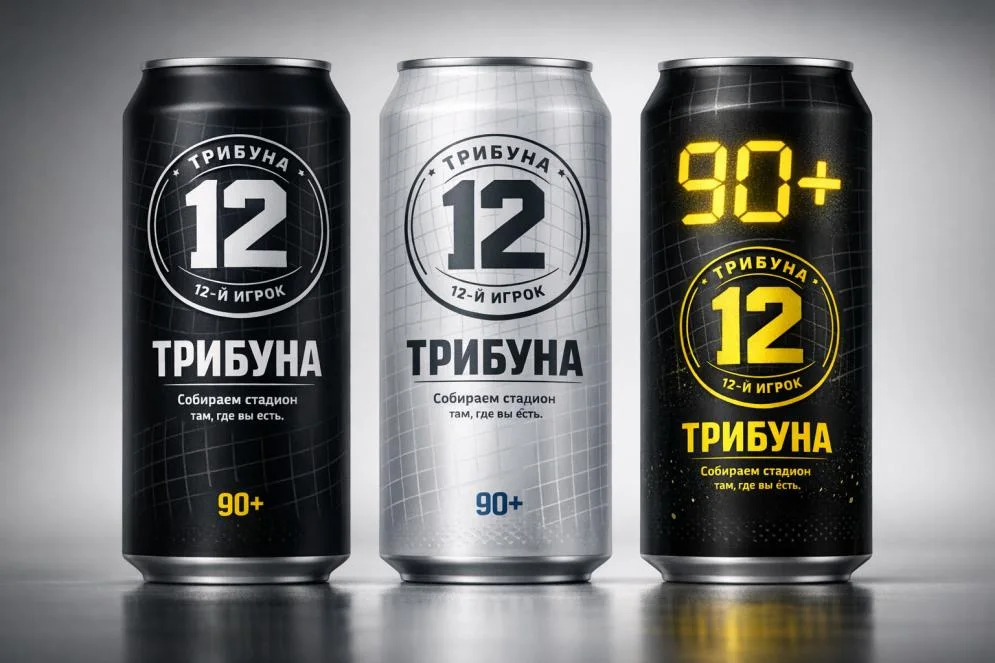
The “12” symbol, the “90+” scoreboard, the goal-net pattern and the claim on every can. A QR code leads to the Matchday Room — the chat for that match.
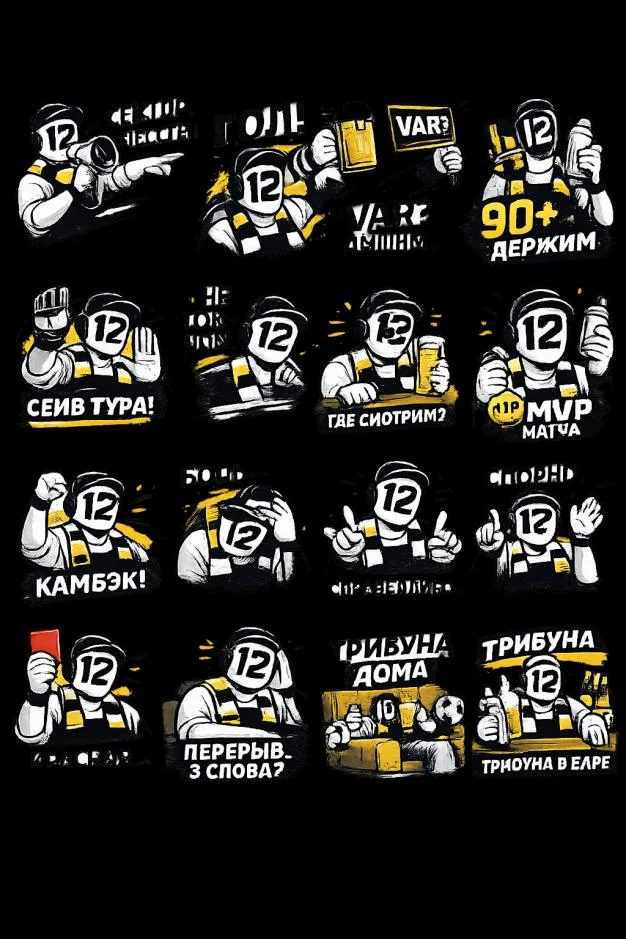
“Sector, take your places!”, “GOAL!”, “VAR? Breathe”, “Holding 90+”, “Save of the round!”, “No toxicity”, “Comeback!”, “Where are we watching?”, “MVP” — ready-made emotions for group chats.
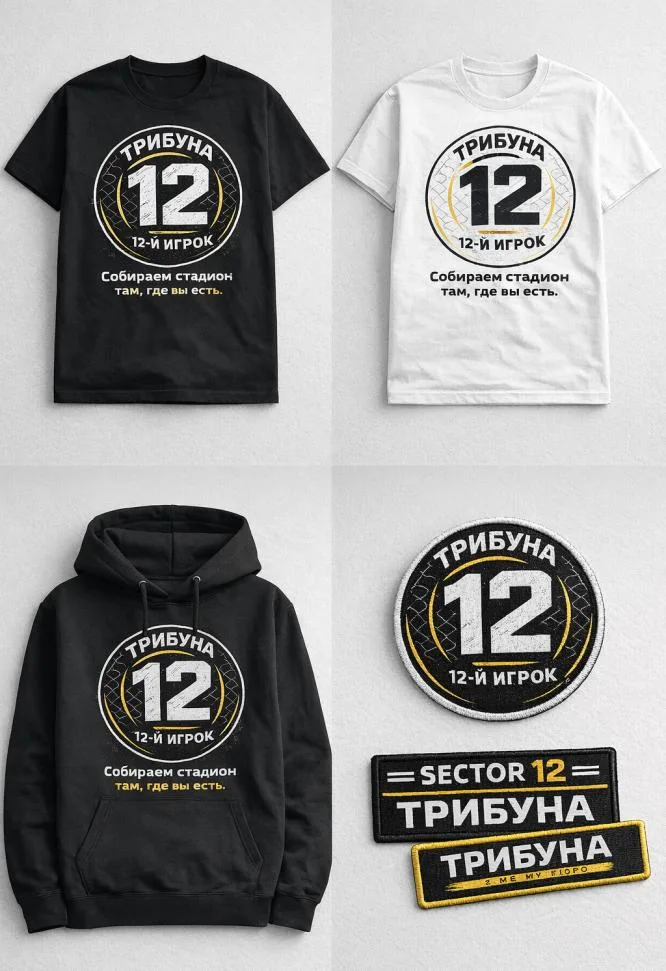
“SECTOR 12” t-shirts, hoodies and patches: badges and limited runs are rewards for contributing to the community, not merely goods.
Visuals from the “Tribuna” test project in our Dissolved Branding handbook.
| Format | Example module | Channel |
|---|---|---|
| POV template | “You, in a bar, on 90+”, “When VAR happens” | TikTok / Reels |
| Stickers | “VAR robbed us”, “Holding 90+”, “Penalty — my heart”, “No toxicity” | Telegram |
| 10-second poll | “Was it a penalty?” · “Player of the match?” | Telegram |
| User content template | “Score __:__ / Where: __ / MVP: __” | IG / VK / TG |
| Argument without the toxicity | “VAR: yes or no? Why — in five words” | TG / VK |
| Post-match board | “Score + 3 facts + meme of the week” | VK |
| Ritual phrase | “Sector, take your places!” + raising scarf or glass to chest height | bar / home |
Open Rules: freedom to remix, with status for contribution
The “12” symbol, the phrases and the goal-net pattern can be dropped freely into memes, stories and fan art — the only things barred are toxicity, politics and club identity. The more a person creates, the higher their standing in the community (the CCL-12 licence):
The launch isn’t of a brand.
It’s of a behaviour
A four-week test: Telegram + 4 stickers + 1 match. Fewer than 20 pieces of user content carrying the “12” and we rebuild the mechanic; more than 50 and we scale. Micro-culture → brand → scale.
We take a proven viral and hand it back with the brand inside
We don’t guess at what might “take off”. We find clips that have already proven themselves with the audience — millions of views — and use AI to rebuild them: original footage that keeps the viral hook, but with the brand embedded inside it. Someone else’s viral format becomes shoppable content: the same compulsive clip, only now your product is in frame — and it’s one step from watching to buying.
Someone else’s clip that has already proven itself: the キラキラクッキング channel, youtube.com/shorts/pvVFITG_Kw4.
YouTube statistics recorded on 14.08.2026.
We rebuilt the clip with AI: the viral mechanic of the perfect pour is intact, but the can in frame is a “Tribuna” carrying the “12” symbol. Original content with no frames copied, ready for seeding and paid distribution as a shoppable clip.
A viral format is an attention loop the audience has already validated: we don’t buy attention from zero, we connect the brand to attention that already exists.
- Competitors copy your product easily and the market is turning into a price war
- Advertising keeps getting more expensive and the audience responds poorly to corporate content
- A community could plausibly form around the product
- You need a young challenger brand
- User content, word of mouth and organic reach matter to your growth
- You want customers to become ambassadors, not just buyers
We don’t start with an ad campaign
We start with a question: what behaviour has to emerge in the audience for the brand to start living on its own? Then we build a minimal version of the brand and test it on a small audience. We watch behaviour rather than likes and reach: are people repeating it? using it? remixing it? sharing it? making their own? If they are, a micro-culture has appeared — and that can be scaled.
The best brands don’t live in advertising, on a website or on packaging — they live in people’s language, in memes, symbols, rituals, communities and the stories customers tell one another. Those are the brands we design.
Let’s test your brand’s potential
Tell us about the product and the audience — we’ll assess where a community could form around it and propose a minimal micro-culture test.
Discuss your brand> dissolved branding: from brand communication — to brand participation